Intentional Operations

Your business works.
But it still needs you
to hold it together.

Not because anything is broken. Because it was never designed to run without you.

Intentional Operations — Why Your Business Still Needs You
The pattern

If your business only runs smoothly when you're involved — it's not a you problem.

Most founder-led businesses don't fail. They work — but only because the founder is mentally inside every loop.

Decisions. Exceptions. Handovers. Escalations.

Nothing is obviously broken. But the business only runs smoothly because you're still holding it together.

As a business grows, complexity rarely shows up how you'd expect. It usually shows up as weight.
  • Decisions technically have owners, but still route back to you
  • Processes work… until something slightly unusual happens
  • Automation reduces manual work but demands more oversight
  • Growth increases coordination cost more than output

The system functions. But it gets unstable when you're absent. So you stay close — not because you want to, but because stepping back feels risky.

The real cause

Why more tools don't fix this.

Most attempts to "fix operations" add surface-level systems — more software, more process, more automation.

But the drag doesn't live at the tool level. It lives in the architecture underneath:

  • how decisions are routed
  • how exceptions are handled
  • where trust is built in — or not
  • what escalates automatically vs manually

If that architecture is implicit — if it happened by accident — the business depends on judgment. And if that judgment lives in your head, the system depends on you.

What changes

When the architecture is clear.

When the underlying rules and flows are explicit rather than held in someone's head:

Interruptions drop

Decisions stay where they belong. The exceptions stop finding their way to you.

Cognitive load falls

Things feel simpler — not because there's less happening, but because less of it requires you.

Predictable under pressure

The business behaves consistently whether you're present or not.

Operational space

A system that keeps moving without constant vigilance — especially from you.

Before redesigning anything

Recognition comes before action.

It helps to notice whether this pattern is actually present — and where it lives. Many strong, stable businesses sit in this state for years: functional, profitable, and quietly dependent.

Most founders suspect it. Few have looked at it clearly.

The book maps the pattern in full. It covers why the dependency forms in the first place, how to find where it lives in your specific business, and what changes when the architecture is redesigned rather than patched.

It won't tell you what to fix. It will help you see what's there.

Once you see it, it's obvious. And hard to unsee.
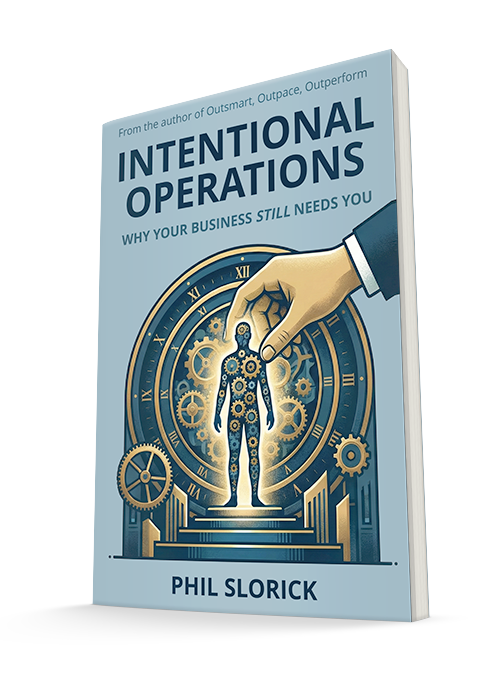
Intentional Operations — Why Your Business Still Needs You
Free download

Get the book.

Enter your email and I'll send you a download link immediately. No pitch. Just the book.

Thanks — check your inbox. The download link is on its way.
If it doesn't arrive within a few minutes, check your spam folder.

If you want to go further.

If the pattern is present and you want to pressure-test it properly — and start actually changing it — Airbase IQ works with service businesses to redesign the architecture and build the systems that make it permanent.

Visit Airbase IQ